 PDRN Care
PDRN vs Polynucleotides: What's the Difference?
PDRN Care Editorial
Regenerative Dermatology Research
The Confusion Between PDRN and PN
If you have spent any time researching regenerative skincare or skin booster treatments, you have almost certainly encountered both PDRN and PN (polynucleotides) used in overlapping — and often confusing — ways. Marketing materials frequently treat these terms as interchangeable, practitioners sometimes use them loosely, and patients are left wondering whether they are the same thing with different names or genuinely different substances.
The answer is nuanced: PDRN and PN share the same biological origin and core mechanism of action, but they differ in meaningful ways that affect how they behave in tissue and which clinical applications they are best suited for [1][6]. This article provides a clear, science-based breakdown of the differences.
The Fundamental Shared Biology
Both PDRN and PN are biopolymers derived from DNA — specifically, from the DNA found in the reproductive cells of fish species [6]. Both consist of chains of deoxyribonucleotides (the building blocks of DNA) linked together in the same chemical structure. Neither contains proteins, lipids, or other cellular components after purification, and neither carries functional genetic information [3].
Both exert their primary biological effects through the same pathway: activation of the adenosine A2A receptor on fibroblasts, endothelial cells, and immune cells [1][7]. This triggers increased collagen synthesis, anti-inflammatory signaling, and angiogenesis [4][8]. Both also contribute nucleotide building blocks to the salvage pathway when degraded by tissue enzymes [1][3].
In other words, PDRN and PN are variations on the same biological theme — not fundamentally different substances. The differences lie in their physical and pharmacokinetic properties [6].
Molecular Weight: The Key Distinction
The primary and most important difference between PDRN and PN is molecular weight, which directly reflects the length of the DNA chains in each product [6].
PDRN: Shorter Chains
PDRN (Polydeoxyribonucleotide) consists of DNA fragments with molecular weights ranging from 50 to 1,500 kilodaltons (kDa) [1][7]. These shorter chains are produced through controlled enzymatic or mechanical fragmentation of larger DNA molecules during the manufacturing process [6].
PN: Longer Chains
Polynucleotides (PN) retain molecular weights above 1,500 kDa, extending up to several thousand kDa [2][3]. These longer chains undergo less fragmentation during extraction, preserving more of the original DNA strand length.
Why Molecular Weight Matters
Chain length directly affects how each product behaves once introduced into tissue [6]:
- Diffusion — Shorter PDRN chains diffuse more readily through the extracellular matrix, spreading from the injection or application point to cover a broader tissue area [1]. Longer PN chains, with their greater hydrodynamic volume, remain more localized [2]
- Degradation rate — PDRN's smaller fragments are broken down more quickly by tissue nucleases, providing a burst of A2A receptor activation and nucleotide substrates [7]. PN degrades more slowly, offering sustained activity over a longer period [3]
- Viscoelastic properties — This is perhaps the most practically significant difference. Longer PN chains exhibit gel-like viscoelastic behavior that shorter PDRN chains lack entirely [2][6]
Viscoelastic Properties: A Critical Functional Difference
When PN chains are long enough, they entangle and interact with each other in solution, creating a viscoelastic gel [6]. This gives PN products a physical scaffolding effect in tissue — they can provide structural support, mild volumization, and a bioscaffolding matrix that PDRN solutions cannot [2].
PDRN solutions, by contrast, behave as thin, freely flowing liquids with no meaningful viscosity [1]. They are absorbed and distributed rapidly but provide no physical structural support.
This difference is why PN-based products are often described as "biorestructuring" agents — they combine the biological signaling of DNA fragments with a physical scaffolding effect that reorganizes tissue architecture [2]. PDRN products are better described as "biorevitalizing" agents — they stimulate cellular activity without adding structural volume [5].
Source Organisms
Both PDRN and PN are extracted from fish gonads, but the specific species can vary [6]:
- PDRN products most commonly use Oncorhynchus keta (chum salmon), though some manufacturers also use Oncorhynchus mykiss (rainbow trout) [1][7]
- PN products, particularly those from Italian manufacturers, frequently use Oncorhynchus mykiss (rainbow trout) as their source [2][3]
The source organism affects the base composition and sequence heterogeneity of the extracted material, though the biological activity at the receptor level is comparable regardless of species [6]. Some practitioners and researchers argue that salmon-derived PDRN has a marginally higher degree of structural homology with human DNA, but this has not been conclusively demonstrated to produce meaningful clinical differences.
Comparing Popular Products
Rejuran (PDRN)
Rejuran, manufactured by Pharma Research Products in South Korea, is the most recognized PDRN brand globally [5]. The Rejuran product line includes:
- Rejuran Healer — The flagship skin booster for general facial rejuvenation. Contains c-PDRN (concentration-optimized PDRN) at 20 mg/2 mL
- Rejuran I — A lower-viscosity formulation designed specifically for the delicate periorbital (under-eye) area
- Rejuran S — A higher-viscosity formulation for scar treatment
- Rejuran HB — Combines PDRN with hyaluronic acid for enhanced hydration
Rejuran products use PDRN extracted from Oncorhynchus keta and are characterized by their thin, freely flowing consistency and broad tissue diffusion [5].
Nucleofill (PN)
Nucleofill, manufactured by Promoitalia in Italy, is a leading polynucleotide brand [2]. Key products include:
- Nucleofill Medium — For general skin rejuvenation with moderate viscoelastic properties
- Nucleofill Strong — Higher concentration for more pronounced biorestructuring
- Nucleofill Medium Plus — Enhanced formula for deeper dermal treatment
Nucleofill products use high molecular weight polynucleotides from Oncorhynchus mykiss and exhibit the gel-like viscoelastic properties characteristic of PN products [2].
Plinest (PN/PDRN Hybrid)
Plinest, manufactured by Mastelli in Italy, occupies an interesting position in the market. While often categorized with PN products, Plinest uses a specific molecular weight distribution that bridges the PDRN and PN categories [3]:
- Plinest — Contains polynucleotides in a formulation designed for broad facial biorevitalization
- Plinest Fast — A pre-filled, ready-to-use format for convenient application
Plinest products are extracted from Oncorhynchus mykiss and offer a balance between the diffusion properties of PDRN and the mild viscoelasticity of PN [3].
Clinical Applications: Choosing Between PDRN and PN
The molecular differences between PDRN and PN translate to distinct clinical strengths [1][2]:
When PDRN Is Preferred
- Broad-area skin rejuvenation — PDRN's superior diffusion makes it ideal for nappage (multiple superficial injection) techniques that treat large facial areas evenly [5]
- Under-eye treatments — The thin periorbital skin benefits from PDRN's gentle, freely diffusing nature. Viscous PN products could create unwanted lumpiness in this delicate area [5]
- Post-procedure recovery — PDRN's rapid anti-inflammatory and wound healing effects make it excellent for accelerating recovery after laser treatments, chemical peels, or surgery [4][7]
- Scalp treatments — For hair growth applications, PDRN's diffusion characteristics allow it to reach hair follicles distributed across a broad area [1]
When PN Is Preferred
- Bioscaffolding and dermal restructuring — PN's viscoelastic gel creates a structural matrix that supports tissue remodeling in areas with significant dermal thinning [2]
- Mild volumization — While not a filler, PN's gel properties provide subtle volume restoration that PDRN cannot achieve [2]
- Sustained treatment effects — PN's slower degradation rate means fewer treatment sessions may be needed for comparable results in some applications [3]
- Deep wrinkle treatment — The combination of biological signaling and physical scaffolding makes PN effective for deeper wrinkles and folds [2]
Combination Approaches
Many advanced practitioners use both PDRN and PN in complementary treatment plans:
- PDRN for the under-eye area, forehead, and overall skin quality improvement [5]
- PN for the mid-face, nasolabial area, and regions benefiting from bioscaffolding [2]
- Alternating between PDRN and PN sessions to leverage the strengths of each
Safety Comparison
Both PDRN and PN have excellent safety profiles with decades of clinical use [1][7]. Because both are purified DNA fragments free of proteins and other immunogenic components, allergic reactions are exceedingly rare for either product category [6]. The most common side effects for both are injection-site related: temporary redness, mild swelling, and occasional bruising [5].
The slightly higher viscosity of PN products means there is a marginally greater risk of palpable nodules if injected too superficially, particularly in thin-skinned areas [2]. This is a technique-dependent consideration rather than a product safety issue.
The Topical Product Landscape
In the topical skincare market, the distinction between PDRN and PN becomes less critical [3]. Most Korean skincare products marketed as "PDRN" serums or creams contain a range of DNA fragment sizes that may technically include both PDRN-weight and PN-weight molecules. The viscoelastic properties that distinguish injectable PN from PDRN are irrelevant in a topical formulation, and the biological activity at the receptor level is comparable [1].
When shopping for topical products, focus on overall formulation quality, concentration, and supporting ingredients rather than worrying about whether the product uses PDRN or PN specifically.
Conclusion
PDRN and PN are closely related but not identical [6]. They share the same biological origin, the same core mechanism of action through the A2A receptor pathway [1][8], and the same excellent safety profile [7]. They differ primarily in molecular weight, which gives PN its characteristic viscoelastic properties and slower degradation [2], while PDRN offers superior diffusion and rapid biological activity [1]. Understanding these differences allows for more informed choices — whether you are selecting an injectable treatment with your practitioner or choosing between topical skincare products for your daily routine.
References
- [1]Squadrito F, Bitto A, Irrera N, et al.. Pharmacological Activity and Clinical Use of PDRN. Curr Pharm Des. 2017;23(27):3948-3957. doi:10.2174/1381612823666170516153716
- [2]Cavallini M, Bartoletti E, Maioli L, et al.. Hyaluronic acid and polynucleotides combination for skin bio-revitalization: a clinical comparison. Dermatol Ther. 2021;34(1):e14572. doi:10.1111/dth.14572
- [3]Colangelo MT, Galli C, Lupi SM. Polydeoxyribonucleotide: A Promising Biological Platform for Dermal Regeneration. Curr Pharm Des. 2020;26(17):2049-2056.
- [4]Galeano M, Bitto A, Altavilla D, et al.. Polydeoxyribonucleotide stimulates angiogenesis and wound healing in the genetically diabetic mouse. Wound Repair Regen. 2008;16(2):208-217. doi:10.1111/j.1524-475X.2008.00361.x
- [5]Kim TH, Kim JY, Yoon JY, et al.. Biostimulatory effects of polydeoxyribonucleotide for facial skin rejuvenation. J Cosmet Dermatol. 2019;18(6):1767-1773. doi:10.1111/jocd.12958
- [6]Veronesi F, Dallari D, Sabbioni G, et al.. Polydeoxyribonucleotides (PDRNs): From Physical Chemistry to Biological Activities. Pharmaceutics. 2017;9(3):28. doi:10.3390/pharmaceutics9030028
- [7]Altavilla D, Squadrito F, Polito F, et al.. PDRN (Defibrotide): Pharmacological Activity and Clinical Applications. Curr Med Chem. 2009;16(11):1389-1395.
- [8]Bitto A, Polito F, Irrera N, et al.. Polydeoxyribonucleotide reduces cytokine production and the severity of collagen-induced arthritis by stimulation of adenosine A2A receptor. Arthritis Res Ther. 2011;13(1):R28.
Recommended Products

Rejuran Healer
Pharmaresearch Products
The original Korean PDRN skin booster — c-PDRN derived from salmon DNA for skin rejuvenation and barrier repair.

Nucleofill Medium
Promoitalia
High-concentration polynucleotide gel for deep skin biorestructuring — Italian-engineered PN technology for tissue regeneration.
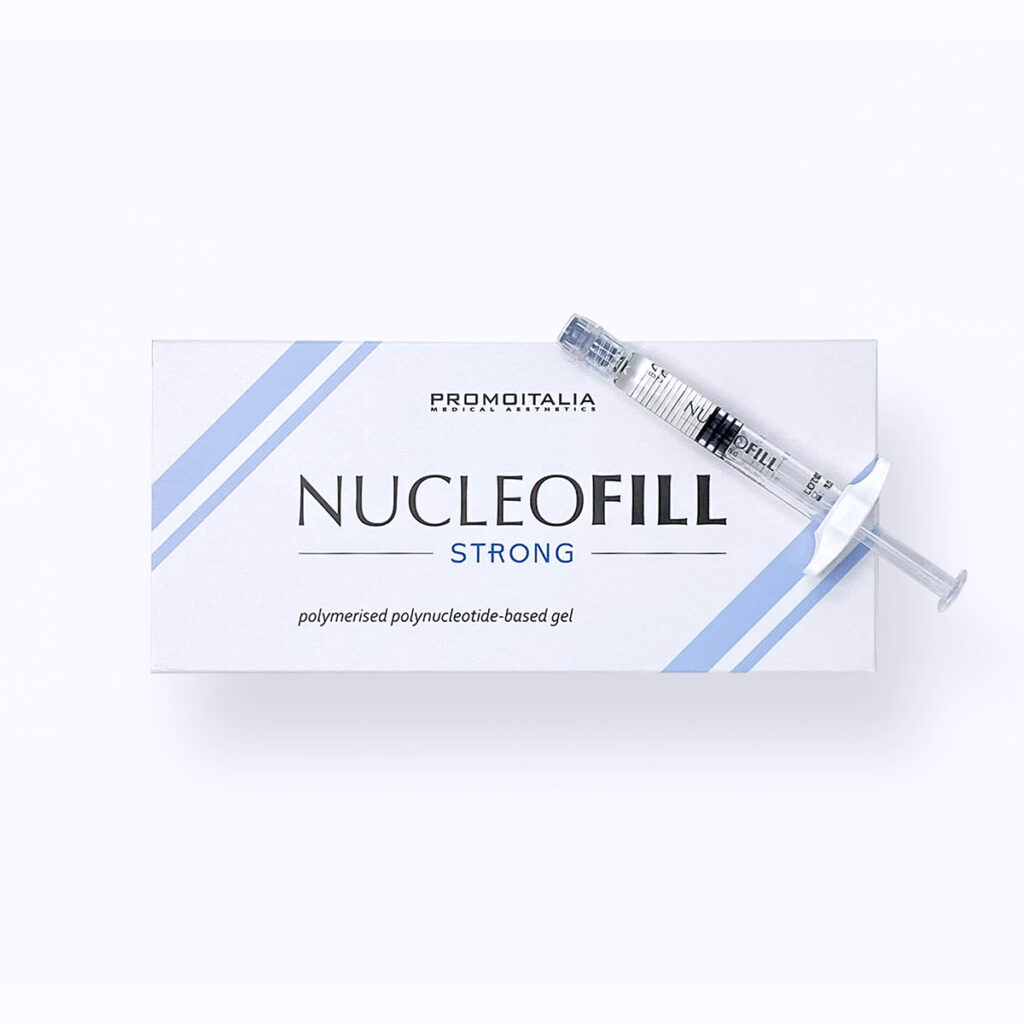
Nucleofill Strong
Promoitalia
High-concentration PDRN gel for professional use — 25mg/mL polynucleotide concentration for intensive rejuvenation.
$200–450 per session

Plinest Fast
Mastelli
Italian PDRN mesotherapy solution by Mastelli — low-molecular-weight formulation for rapid tissue repair and wound healing applications.
Related Posts
What is PDRN? The Complete Guide to Salmon DNA Skincare
PDRN (Polydeoxyribonucleotide) is a DNA-derived skincare ingredient extracted from salmon. Learn what PDRN means, how it works, its benefits for skin, and the different product types available.
PDRN Cream: Benefits, How to Choose, and Top Korean Picks
A complete guide to PDRN creams — learn the benefits over serums, how to choose the right formula, and discover the best Korean PDRN creams from Genabelle, Heveblue, and Anua.
Best PDRN Serums 2026: Korean Salmon DNA Serums Ranked
We rank the best PDRN serums of 2026, including top Korean salmon DNA serums from Medicube, Anua, Genabelle, Numbuzin, Frankly, and IOPE. Find the right PDRN serum for your skin.