 PDRN Care
PDRN for Morning Face Puffiness: Supporting Drainage & Skin Resilience
Morning face puffiness is the swollen, heavy, slightly bloated appearance many people see when they first wake up — most noticeable across the cheeks, under the eyes, and along the jawline, and usually settling over the first hour or two of being upright and active. It is primarily a fluid-distribution phenomenon rather than a fat or structural change: while you lie flat overnight, gravity no longer pulls fluid downward, so interstitial fluid and lymph pool in the loose tissues of the face. Contributing factors include high dietary salt, alcohol, poor sleep, crying, hormonal shifts, sleeping position, sinus congestion, and simply the natural overnight redistribution of body fluids. Because the skin around the eyes and cheeks is thin and laxly attached, even small amounts of retained fluid show clearly here as puffiness and creasing.
How PDRN Targets Morning Face Puffiness
PDRN helps morning face puffiness by improving the resilience and drainage capacity of the facial tissue rather than by acutely dehydrating it. First, PDRN stimulates fibroblast proliferation and the synthesis of type I and type III collagen and elastin through adenosine A2A receptor activation. Firmer, more elastic skin with a denser dermal matrix holds pooled fluid less readily and recovers its shape faster once you are upright, so the same overnight fluid shift produces less visible and shorter-lived swelling. This directly counters the age-related loss of firmness that makes puffiness worse and more persistent over time. Second, PDRN promotes healthy angiogenesis and improves microcirculation in the facial tissues. Efficient venous and lymphatic return is what clears the interstitial fluid responsible for morning puffiness; by supporting a healthier microvascular network and better perfusion, PDRN helps the tissue drain and recover more effectively. Third, PDRN's well-documented anti-inflammatory action — suppressing pro-inflammatory cytokines such as TNF-alpha and IL-6 — reduces the inflammatory component of puffiness that appears with poor sleep, alcohol, crying, or reactive skin, where swelling is driven not only by fluid pooling but by inflammatory vasodilation and permeability. Fourth, by supporting extracellular matrix quality and glycosaminoglycan balance, PDRN helps the tissue maintain appropriate hydration and fluid handling, so water is held where it belongs rather than pooling loosely in lax tissue. The result is not an instant morning fix but a tissue that is firmer, better drained, and less inflammation-prone — a face that puffs less and clears faster. PDRN is best combined with sensible evening habits (lower salt and alcohol, good sleep, head elevation) and mechanical depuffing (cold, facial massage or rolling) for both immediate and long-term improvement.
Recommended Products (4)
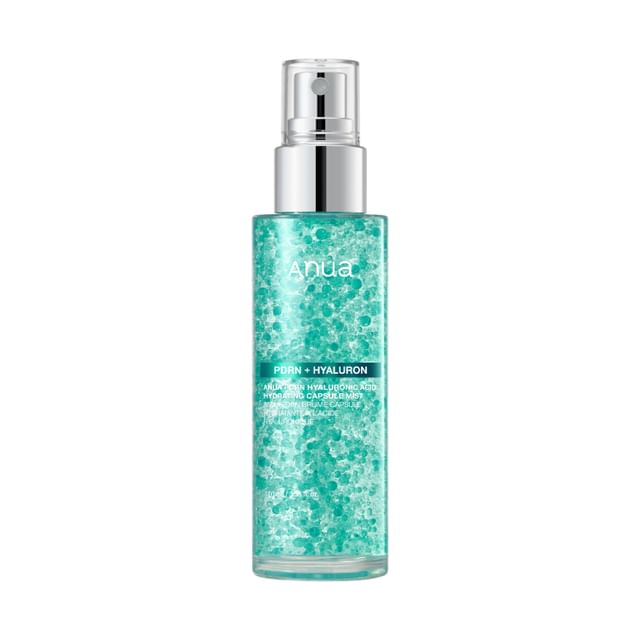
PDRN Hyaluronic Acid Hydrating Capsule Mist
Anua
Hydrating capsule mist with PDRN and hyaluronic acid for instant moisture boost throughout the day.
$19–26

Revive PDRN Serum
Beauty of Joseon
A traditional-medicine inspired PDRN serum from Beauty of Joseon, blending salmon PDRN with rice extract and ginseng for resilient, glowing skin.
$19–25
PDRN Calming Serum
Isntree
Gentle, fast-absorbing PDRN serum formulated with centella and green tea to calm reactive skin while promoting cellular repair.
$25–35

DIVE-IN Low Molecular PDRN Serum
Torriden
Lightweight hydrating PDRN serum built around Torriden's signature 5D low-molecular hyaluronic acid complex for deep, layered hydration.
$22–30
Most morning puffiness is transient and benign, resolving on its own as lymphatic and venous return clear the pooled fluid once you stand and move. The usual self-care — reducing evening salt and alcohol, staying hydrated, elevating the head during sleep, cold compresses, and gentle lymphatic massage or facial rolling — genuinely speeds this along. What these measures do not address is the *quality of the tissue itself*: as skin ages and loses collagen, elastin, and firmness, it holds fluid more readily, drains more sluggishly, and rebounds less crisply, so the same overnight fluid shift produces more visible and longer-lasting puffiness. In other words, a big part of why some faces puff more, and stay puffy longer, is declining skin resilience and microcirculatory efficiency.
This is where PDRN (polydeoxyribonucleotide) contributes, not as a same-morning depuffing trick but as a way to improve the underlying tissue so it manages fluid better over time. Through activation of the adenosine A2A receptor, PDRN stimulates fibroblasts to rebuild collagen and elastin, restoring the firmness and elastic recoil that help tissue resist pooling and bounce back faster. It promotes angiogenesis and improves microcirculation, supporting more efficient clearance of fluid and metabolic waste from the facial tissues, and its anti-inflammatory action reduces the low-grade inflammatory swelling that compounds puffiness in reactive or sleep-deprived skin. PDRN will not replace cold compresses and lymphatic massage on the morning of a big event — but by improving skin firmness, vascular quality, and inflammatory tone, it addresses why the face became prone to lingering puffiness in the first place.
Frequently Asked Questions
Will PDRN depuff my face in the morning like a cold compress does?
How does PDRN reduce puffiness if it isn't a diuretic?
How long does PDRN take to help with facial puffiness?
Can I use PDRN under my eyes for morning puffiness and bags?
Sources
- Squadrito F, Bitto A, Irrera N, Pizzino G, Pallio G, Minutoli L, Altavilla D. “Pharmacological Activity and Clinical Use of PDRN.” Current Pharmaceutical Design 23(27): 3948-3957 (2017). doi:10.2174/1381612823666170516153716
- Bitto A, Polito F, Irrera N, D'Ascola A, Avenoso A, Nastasi G, Campo GM, Micali A, Squadrito F, Altavilla D. “Polydeoxyribonucleotide reduces cytokine production and the severity of collagen-induced arthritis by stimulation of adenosine A2A receptor.” Arthritis Research & Therapy 13(1): R28 (2011). doi:10.1186/ar3258
Other PDRN Skin Concerns
PDRN for Active Acne
Active acne breakouts are driven by a cycle of excess sebum production, bacterial colonization (prim…
PDRN for Acne Scars
Acne scars represent one of the most challenging dermatological conditions to treat, affecting an es…
PDRN for Age Spots
Age spots — medically known as solar lentigines or liver spots — are flat, well-defined hyperpigment…
PDRN for Angular Cheilitis
Angular cheilitis is the inflammation, cracking, and soreness that develops at one or both corners o…
PDRN for Anti-Aging
Skin aging is a complex biological process driven by both intrinsic factors (genetics, hormonal chan…
PDRN for Blackheads
Blackheads (open comedones) are one of the most common and persistent skin concerns, affecting the n…
PDRN for Blue Light Damage
Blue light, or high-energy visible (HEV) light in the 380-500nm wavelength range, is emitted by smar…
PDRN for Body Acne
Body acne — occurring on the back (bacne), chest, shoulders, and upper arms — affects approximately …
PDRN for Broken Capillaries
Broken capillaries — medically known as telangiectasia — are permanently dilated small blood vessels…
PDRN for Bunny Lines
Bunny lines are the fine, diagonal wrinkles that fan out across the upper nose and toward the inner …
PDRN for Cellulite
Cellulite affects an estimated 80-90% of post-pubertal women and is characterized by the dimpled, un…
PDRN for Chapped Hands
Chapped hands are rough, dry, tight, red, and sometimes cracked or peeling — skin that stings when y…
PDRN for Chapped Lips
Chapped lips — dry, cracked, flaking, sometimes sore or bleeding lips — are one of the most common s…
PDRN for Chest Wrinkles
Chest wrinkles — also known as decolletage lines or cleavage wrinkles — are a common and often distr…
PDRN for Chickenpox Scars
Chickenpox scars are the lasting reminders of a varicella infection, and they are among the most stu…
PDRN for Chin Wrinkles
Chin wrinkles are the creases, dimpling, and crepey texture that appear on and around the chin — fro…
PDRN for Closed Comedones
Closed comedones are the small, flesh-colored or slightly white bumps that give skin a rough, uneven…
PDRN for Combination Skin
Combination skin is the most common skin type, characterised by an oily T-zone — the forehead, nose,…
PDRN for Contact Dermatitis
Contact dermatitis is the red, itchy, inflamed rash that develops when the skin reacts to something …
PDRN for Cortisol Skin Damage
Cortisol skin damage is the cumulative deterioration of skin structure, barrier function, and appear…
PDRN for Cracked Heels
Cracked heels — dry, thickened skin around the heel that splits into visible fissures — are a common…
PDRN for Crepey Arms
Crepey arms are the thin, finely wrinkled, loosely textured skin that develops on the upper arms and…
PDRN for Crepey Skin
Crepey skin describes a distinctive type of skin aging characterized by thin, finely wrinkled, fragi…
PDRN for Crow's Feet
Crow's feet — clinically known as lateral canthal lines — are the fan-shaped wrinkles that radiate o…
PDRN for Cystic Acne
Cystic acne is the most severe and stubborn form of acne, marked by large, deep, painful nodules and…
PDRN for Dark Circles
Dark circles under the eyes are one of the most common cosmetic complaints, affecting people of all …
PDRN for Dark Elbows and Knees
Dark, rough patches on the elbows and knees are one of the most common and stubborn body-skin concer…
PDRN for Dark Inner Thighs
Dark inner thighs are a very common and completely harmless form of body hyperpigmentation — patches…
PDRN for Dark Knuckles
Dark knuckles are patches of hyperpigmentation that develop over the finger joints, and sometimes ov…
PDRN for Dark Lips
Dark lips — a dusky, uneven, or hyperpigmented tone across the lip surface and border — are a common…
PDRN for Dark Underarms
Dark underarms — a brownish or grayish discoloration of the armpit skin — are extremely common and r…
PDRN for Dehydrated Skin
Dehydrated skin is one of the most widely misunderstood skin conditions because it is frequently con…
PDRN for Digital Aging
Digital aging is the accelerated skin aging pattern driven by the combined effects of prolonged scre…
PDRN for a Double Chin
A 'double chin' — the fullness or looseness beneath the jaw and chin — is one of the most common con…
PDRN for Dry Skin
Dry skin, or xerosis, is a widespread condition characterized by a compromised stratum corneum that …
PDRN for Dull Skin
Dull skin lacks luminosity due to slow cell turnover, poor circulation, and accumulated surface dama…
PDRN for Eczema
Eczema — clinically known as atopic dermatitis (AD) — is a chronic, relapsing inflammatory skin dise…
PDRN for Enlarged Pores
Enlarged pores are one of the most common aesthetic complaints, affecting patients across all ages a…
PDRN for Eye Bags
Eye bags — the puffy, swollen appearance under the eyes — are one of the most common cosmetic concer…
PDRN for Eyelid Aging
Eyelid aging is one of the earliest and most impactful signs of facial aging, significantly affectin…
PDRN for Facial Redness
Facial redness is one of the most common skin complaints, and one of the most varied in its causes. …
PDRN for Fine Lines & Wrinkles
Fine lines and wrinkles develop as the dermis loses its structural scaffolding — collagen production…
PDRN for Flaky Skin
Flaky skin — the visible shedding of small, dry, sometimes rough or peeling scales — is one of the m…
PDRN for Forehead Expression Lines
Forehead expression lines are the dynamic creases that appear when you raise your eyebrows, furrow y…
PDRN for Forehead Wrinkles
Forehead wrinkles — clinically referred to as frontalis lines — are the horizontal creases that run …
PDRN for Frown Lines
Frown lines — often called the 'elevens' or glabellar lines — are the vertical creases that form bet…
PDRN for Fungal Acne
Fungal acne is the small, uniform, often itchy bumps that cluster on the forehead, hairline, chest, …
PDRN for Hair Growth
Hair loss affects approximately 50% of men and 25% of women by the age of 50, with androgenetic alop…
PDRN for Hand Rejuvenation
The hands are among the first areas of the body to reveal visible signs of aging, yet they remain on…
PDRN for Heat Rash
Heat rash — also called prickly heat or miliaria — is the itchy, prickly, bumpy irritation that erup…
PDRN for Hooded Eyes
Hooded eyes occur when a fold of upper-eyelid skin sags down over the crease, partly covering the la…
PDRN for Hormonal Acne
Hormonal acne is a persistent, often frustrating form of acne driven primarily by fluctuations in an…
PDRN for Hyperpigmentation
Hyperpigmentation is one of the most common dermatological concerns worldwide, affecting an estimate…
PDRN for Ingrown Hairs
Ingrown hairs occur when a hair curls back or grows sideways into the skin instead of emerging from …
PDRN for Jawline Sagging
Jawline sagging — clinically referred to as lower face laxity or jowl formation — is one of the most…
PDRN for Jowl Sagging
Jowl sagging is the descent of skin and soft tissue along the lower jawline, creating the characteri…
PDRN for Keloid Scars
Keloid scars are a pathological form of wound healing characterized by excessive, disorganized colla…
PDRN for Keratosis Pilaris
Keratosis pilaris (KP) is one of the most common skin conditions, affecting approximately 50-80% of …
PDRN for Knee Wrinkles
Knee wrinkles are the folds, crepey texture, and softly sagging skin that develop on and above the k…
PDRN for Lip Lines
Lip lines — clinically known as perioral wrinkles or perioral rhytids — are the fine vertical crease…
PDRN for Lip Volume Loss
Lip volume loss is one of the earliest and most noticeable signs of facial aging, beginning as early…
PDRN for Loss of Facial Volume
Loss of facial volume is one of the most significant and visible signs of aging, transforming the fa…
PDRN for Marionette Lines
Marionette lines are the vertical creases that run from the corners of the mouth downward toward the…
PDRN for Maskne
Maskne — a portmanteau of mask and acne — is the cluster of breakouts, irritation, and redness that …
PDRN for Melasma
Melasma is a chronic hyperpigmentation disorder characterized by irregular brown or grayish-brown pa…
PDRN for Menopausal Skin
Menopausal skin changes are among the most rapid and noticeable shifts many people experience, and t…
PDRN for Milia
Milia are small, firm, white-to-yellow cysts that form just beneath the surface of the skin, most co…
PDRN for Nasolabial Folds
Nasolabial folds — commonly called smile lines, laugh lines, or parentheses lines — are the creases …
PDRN for Neck Aging
The neck is one of the first areas of the body to reveal visible signs of aging, yet it is also one …
PDRN for Neck Lines
Neck lines — the horizontal creases that ring the neck like necklaces and the vertical cords that em…
PDRN for Oily Scalp
An oily scalp is the familiar cycle of hair that looks flat and greasy within a day of washing, a sh…
PDRN for Oily Skin
Oily skin is one of the most common skin types, characterized by excess sebum production from overac…
PDRN for Ozempic Face
"Ozempic face" is the popular name for the gaunt, hollowed, prematurely aged appearance that can fol…
PDRN for Perioral Dermatitis
Perioral dermatitis is a chronic, relapsing inflammatory rash that appears as clusters of small red …
PDRN for Perioral Hyperpigmentation
Perioral hyperpigmentation is darkening of the skin around the mouth — a shadowy, brownish or grayis…
PDRN for Perioral Wrinkles
Perioral wrinkles, commonly known as smoker's lines or lip lines, are the fine vertical creases that…
PDRN for Photoaged Skin
Photoaging refers to the premature aging of skin caused by cumulative exposure to ultraviolet (UV) r…
PDRN for Post-Acne Marks
Post-acne marks are the flat, discolored spots that remain on the skin after an acne lesion has heal…
PDRN for Post-Acne Redness (PIE)
Post-inflammatory erythema (PIE) is the persistent red or pink discoloration left behind after acne …
PDRN for Post-Inflammatory Erythema (PIE)
Post-inflammatory erythema (PIE) refers to the flat, pink-to-red marks that persist on the skin afte…
PDRN for Post-Procedure Recovery
Post-procedure recovery is a critical phase that directly impacts the outcome of aesthetic treatment…
PDRN for Post-Surgical Scarring
Post-surgical scarring is the inevitable result of any procedure that disrupts skin integrity, from …
PDRN for Puffy Eyes
Puffy eyes (periorbital edema) are one of the most common cosmetic concerns, affecting people of all…
PDRN for Razor Burn
Razor burn is the red, stinging, inflamed irritation that appears minutes to hours after shaving, mo…
PDRN for Rosacea
Rosacea is a chronic inflammatory skin condition affecting over 400 million people worldwide, charac…
PDRN for Rough Skin Texture
Rough skin texture refers to an uneven, bumpy, or coarse feel to the skin surface that lacks the smo…
PDRN for Sagging Skin
Sagging skin — clinically referred to as skin laxity — is one of the most challenging and visible si…
PDRN for Sallow Skin
Sallow skin is that unhealthy yellowish, greyish, or tired-looking cast that settles over a complexi…
PDRN for Scalp Dryness
Scalp dryness is a common condition affecting millions of people, characterized by tightness, itchin…
PDRN for Sebaceous Filaments
Sebaceous filaments are one of the most misunderstood features of oily skin. Unlike blackheads, they…
PDRN for Seborrheic Dermatitis
Seborrheic dermatitis is a common, chronic inflammatory skin condition that causes red, flaky, somet…
PDRN for Sensitive Skin
Sensitive skin is one of the most common dermatological complaints worldwide, with approximately 50%…
PDRN for Skin Barrier Repair
The skin barrier — also known as the stratum corneum or acid mantle — is your body's first line of d…
PDRN for Post-Illness Skin Dullness
Skin dullness after illness is a common but often overlooked concern that affects anyone recovering …
PDRN for Skin Elasticity Loss
Skin elasticity refers to the skin's ability to stretch and snap back to its original shape — the qu…
PDRN for Skin Firmness
Loss of skin firmness is one of the earliest and most universally experienced signs of aging, often …
PDRN for Skin Hydration
Skin hydration goes far deeper than surface moisture — it reflects the health and function of the en…
PDRN and Skin Purging
Skin purging is a temporary worsening of breakouts that occurs when certain active ingredients accel…
PDRN for Skin Texture
Skin texture refers to the surface quality of the skin — how smooth, even, and refined it appears an…
PDRN for Skin Thinning
Skin thinning — clinically termed dermal atrophy — is the progressive reduction in skin thickness th…
PDRN for Sleep Lines
Sleep lines are the creases that form when your face is pressed and folded against a pillow for hour…
PDRN for Sparse Eyebrows
Sparse eyebrows are brows that look thin, patchy, or gappy — whether from over-plucking, age-related…
PDRN for Spider Veins
Spider veins, medically known as telangiectasias, are small, dilated blood vessels visible near the …
PDRN for Strawberry Legs
Strawberry legs is the common name for the dotted, speckled appearance of the lower legs where hair …
PDRN for Stretch Marks
Stretch marks (striae distensae) are a form of dermal scarring that affects up to 90% of women durin…
PDRN for Sun Damage
Sun damage (photoaging) is the single largest contributor to premature skin aging, responsible for u…
PDRN for Sunburn Recovery
Sunburn is an acute inflammatory injury to the skin caused by overexposure to ultraviolet radiation,…
PDRN for Tear Troughs
Tear troughs are the concave depressions that extend from the inner corner of the eye (medial canthu…
PDRN for Tech Neck
Tech neck — a term coined to describe premature neck aging caused by prolonged and repetitive downwa…
PDRN for Textured Forehead
A textured forehead refers to a common skin concern characterized by an uneven, bumpy, or rough surf…
PDRN for Turkey Neck
Turkey neck is the colloquial term for the combination of sagging skin, visible platysma bands, and …
PDRN for Under-Eye Wrinkles
Under-eye wrinkles are among the earliest and most visible signs of facial aging, appearing as fine …
PDRN for Uneven Skin Tone
Uneven skin tone results from irregular melanin distribution, chronic micro-inflammation, impaired c…
PDRN for Vitiligo
Vitiligo is a chronic autoimmune condition in which the immune system destroys melanocytes — the pig…
PDRN for Whiteheads
Whiteheads are a form of closed comedo — a hair follicle that has become plugged with a mix of exces…
PDRN for Windburn
Windburn is the dry, red, tight, and stinging skin that develops after prolonged exposure to cold, h…
PDRN for Wound Healing
Wound healing is the foundational clinical application of PDRN — it is where the entire field of pol…