 PDRN Care
PDRN Concentration Levels Explained: How Much PDRN Do You Need?
Dr. Sarah Chen
PhD, Molecular Biology
Why Concentration Matters
When shopping for PDRN products, you will encounter a wide range of stated concentrations — from 1% topical serums to 20mg/mL injectable solutions. Understanding what these numbers mean and how much PDRN you actually need is essential for making informed purchase decisions and setting realistic expectations.
Not all PDRN concentrations are equally effective, and higher is not always better. The optimal concentration depends on the delivery method (topical vs. injectable), your skin concerns, and what the clinical evidence actually supports [1][5].
PDRN Concentration in Topical Products
Common Concentration Ranges
Topical PDRN products — serums, ampoules, creams, and masks — typically contain:
| Concentration | Category | Typical Products |
|---|---|---|
| < 1% | Low | Basic moisturizers with PDRN as a secondary ingredient |
| 1-5% | Standard | Most K-beauty PDRN serums and ampoules |
| 5-10% | High | Premium serums and concentrated ampoules |
| > 10% | Very high | Specialty products; effectiveness over 10% is debated |
What the Research Shows
Most in vitro studies demonstrating PDRN's biological activity use concentrations of 8-100 μg/mL (roughly equivalent to 0.001-0.01%) [1][4][5]. This is important context — PDRN is biologically active at very low concentrations at the cellular level.
However, topical delivery is inefficient. Not all PDRN in a serum reaches the target cells in the dermis. Factors that reduce effective delivery include:
- Skin barrier — The stratum corneum limits penetration of large molecules
- Degradation — Nucleases in the skin can break down PDRN before it reaches target cells
- Dilution — Product spreads across a large skin surface area
This means topical products need significantly higher concentrations than what works in a petri dish to deliver sufficient PDRN to dermal cells.
Practical Recommendations for Topical Products
Based on the available evidence and clinical experience [1][2][3]:
- Minimum effective: 1-2% — Provides baseline hydration and mild regenerative support
- Optimal for daily use: 3-5% — Balances efficacy with cost and formulation stability
- High-performance: 5-10% — For targeted treatment of specific concerns (scars, aging, recovery)
- Above 10%: Diminishing returns — additional PDRN beyond 10% adds cost without proportionally more benefit, as the skin can only absorb and utilize a limited amount per application
PDRN Concentration in Injectable Products
Injectable PDRN bypasses the skin barrier entirely, delivering the molecule directly to the dermis. This is why injectable treatments produce more dramatic results than topical products [2].
Clinical-Grade Injectable Concentrations
| Product Type | Typical Concentration | Delivery Volume |
|---|---|---|
| Skin boosters (e.g., Rejuran) | 15-20 mg/mL | 2-4 mL per session |
| Mesotherapy solutions | 5-10 mg/mL | Variable |
| PDRN for microneedling | 5-20 mg/mL | 2-5 mL applied topically during procedure |
The most-studied injectable concentration is the Rejuran Healer formulation at approximately 15 mg/mL, which has been used in multiple clinical trials showing significant improvements in skin elasticity, hydration, and wrinkle reduction [2].
Why Injectable Concentrations Are Higher
Injectable PDRN solutions use much higher concentrations than topical products because:
- Direct delivery — The PDRN reaches the dermis without barrier penetration losses
- Controlled dosing — A known amount is delivered to a defined tissue area
- Sustained release — PDRN gel in the dermis provides extended release as the gel matrix slowly breaks down
- Clinical evidence base — Concentrations are optimized through clinical trials [2]
Understanding Product Labels
What to Look For
When evaluating a PDRN product, check for:
- Stated PDRN percentage — Look for products listing a specific concentration (e.g., "5% PDRN")
- Position in ingredient list — In products without a stated percentage, PDRN should appear in the first 5-10 ingredients
- Source specification — Quality products specify "Polydeoxyribonucleotide from Oncorhynchus keta" (chum salmon)
- Molecular weight range — Some brands specify the molecular weight distribution (50-1500 kDa is the typical therapeutic range) [5]
Red Flags
Be cautious about:
- "PDRN-enriched" or "with PDRN" without a stated percentage — may contain negligible amounts
- Unrealistically high claimed concentrations (e.g., "50% PDRN serum") — at very high concentrations, the product would be extremely viscous and difficult to formulate
- Salmon DNA vs. PDRN — Raw salmon DNA extract is not the same as purified, pharmaceutical-grade PDRN. Some products use "salmon DNA" at the ingredient level while marketing as PDRN
- No source organism specified — Authentic PDRN comes from specific salmon species; non-specific "DNA" or "polynucleotide" ingredients may be different molecules
How Concentration Relates to Results
Topical Results by Concentration
Based on user reports and available evidence [1][2][3]:
1-2% PDRN serums:
- Improved hydration within 1-2 weeks
- Mild barrier support
- Subtle texture improvement over 4-6 weeks
3-5% PDRN serums:
- Noticeable hydration improvement within 1 week
- Visible texture improvement within 3-4 weeks
- Gradual fine line softening over 6-8 weeks
- Reduced post-shave/post-procedure irritation
5-10% PDRN serums:
- Rapid hydration improvement
- Measurable texture and tone improvement within 2-3 weeks
- More significant fine line and scar improvement over 6-12 weeks
- Effective post-procedure support
Professional Treatment Results
Injectable PDRN (15-20 mg/mL) [2]:
- Measurable elasticity improvement after 2-3 sessions
- Significant wrinkle reduction after a full course (4-6 sessions)
- Improved skin thickness on ultrasound
- Results lasting 6-12 months with maintenance
PDRN vs. PN: A Concentration Note
A common source of confusion is the difference between PDRN and PN (polynucleotide). Both are DNA-derived molecules, but they have different molecular weight profiles:
- PDRN: 50-1500 kDa (optimized for A2A receptor binding) [1][5]
- PN: Up to 10,000+ kDa (broader molecular weight distribution)
When comparing concentrations, a "10% PN" product is not equivalent to a "10% PDRN" product. The biological activity profile differs due to the molecular weight distribution, and the two should not be compared on concentration alone.
Maximizing Your PDRN Investment
For Topical Products
- Choose 3-5% for daily use — best balance of efficacy and value
- Apply to slightly damp skin — enhances penetration
- Use consistently — daily application matters more than occasional high-concentration use
- Consider delivery enhancers — products that combine PDRN with hyaluronic acid or other humectants can improve penetration
- Professional treatments boost results — a PDRN facial or microneedling session every 1-3 months amplifies daily topical benefits
For Professional Treatments
- Standard protocols are well-validated — 15-20 mg/mL injectable PDRN in a series of 3-6 sessions has robust clinical evidence [2]
- Don't chase maximum concentration — the clinical evidence supports specific protocols; "extra strength" injectables are not necessarily more effective
- Maintenance matters — follow initial treatment courses with maintenance sessions and daily topical PDRN for sustained results
The Bottom Line
PDRN concentration matters, but more is not always better. For topical products, 3-5% PDRN delivers reliable daily benefits, while 5-10% targets specific concerns more aggressively [1][3]. For injectable treatments, the well-studied 15-20 mg/mL concentration range produces the results documented in clinical trials [2]. Focus on consistent use of a quality product at an appropriate concentration rather than chasing the highest number on the label. And regardless of concentration, verify the source — genuine PDRN from Oncorhynchus keta with proper purification is what the evidence supports [5].
References
- [1]Squadrito F, Bitto A, Irrera N, et al.. Pharmacological Activity and Clinical Use of PDRN. Curr Pharm Des. 2017;23(27):3948-3957. doi:10.2174/1381612823666170516153716
- [2]Kim TH, Kim JY, Bae JH, et al.. Biostimulatory effects of polydeoxyribonucleotide for facial skin rejuvenation. J Cosmet Dermatol. 2019;18(6):1767-1773. doi:10.1111/jocd.12958
- [3]Colangelo MT, Galli C, Giannelli M. Polydeoxyribonucleotide: A Promising Biological Platform for Dermal Regeneration. Curr Pharm Des. 2020;26(17):2049-2056.
- [4]Galeano M, Bitto A, Altavilla D, et al.. Polydeoxyribonucleotide stimulates angiogenesis and wound healing in the genetically diabetic mouse. Wound Repair Regen. 2008;16(2):208-217. doi:10.1111/j.1524-475X.2008.00361.x
- [5]Veronesi F, Dallari D, Sabbioni G, Carubbi C, Martini L, Fini M. Polydeoxyribonucleotides (PDRNs): From Physical Chemistry to Biological Activities and Clinical Applications. Int J Mol Sci. 2017;18(9):1927. doi:10.3390/ijms18091927
- [6]Noh TK, Chung BY, Kim SY, et al.. Novel Anti-Melanogenesis Properties of Polydeoxyribonucleotide, a Popular Wound Healing Booster. Int J Mol Sci. 2016;17(9):1448. doi:10.3390/ijms17091448
Recommended Products

5 PDRN Collagen Intense Vitalizing Serum
COSRX
Multi-PDRN formula with 5 types of PDRN from salmon, centella, rice, lactobacillus, and sea grapes plus low-molecular collagen.
$30–40

Nucleofill Medium
Promoitalia
High-concentration polynucleotide gel for deep skin biorestructuring — Italian-engineered PN technology for tissue regeneration.
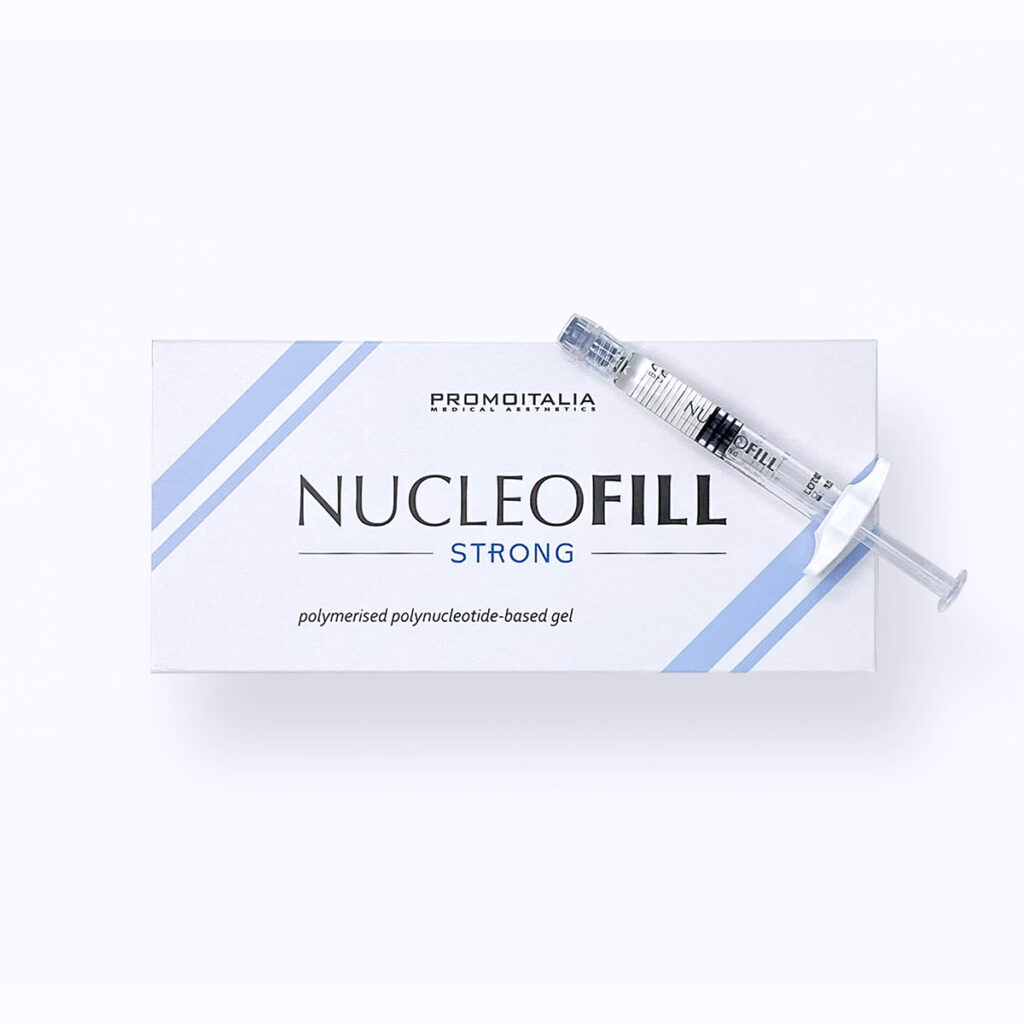
Nucleofill Strong
Promoitalia
High-concentration PDRN gel for professional use — 25mg/mL polynucleotide concentration for intensive rejuvenation.
$200–450 per session

PDRN Pink Peptide Serum
Medicube
Viral K-beauty serum with 99% purity salmon DNA PDRN and 5 peptides for instant glow and visible firming within a week.
$20–25

Rejuran Healer
Pharmaresearch Products
The original Korean PDRN skin booster — c-PDRN derived from salmon DNA for skin rejuvenation and barrier repair.
Related Posts
What is PDRN? The Complete Guide to Salmon DNA Skincare
PDRN (Polydeoxyribonucleotide) is a DNA-derived skincare ingredient extracted from salmon. Learn what PDRN means, how it works, its benefits for skin, and the different product types available.
How to Use PDRN Serum: A Step-by-Step Skincare Routine Guide
Learn exactly how to use PDRN serum in your skincare routine — when to apply it, how much to use, what to layer it with, and common mistakes to avoid.
Best PDRN Serums 2026: Korean Salmon DNA Serums Ranked
We rank the best PDRN serums of 2026, including top Korean salmon DNA serums from Medicube, Anua, Genabelle, Numbuzin, Frankly, and IOPE. Find the right PDRN serum for your skin.