 PDRN Care
The Salmon Sperm Facial, Explained: What PDRN Really Is Behind the Viral Name
Dr. Min-Ji Park
MD, Board-Certified Dermatologist
Where the Name Came From
Every few months a skincare treatment breaks out of dermatology clinics and into group chats, usually with a name engineered to make people click. The "salmon sperm facial" is the current example. Celebrities mentioned it, headlines ran with it, and suddenly a decades-old regenerative ingredient had the most attention-grabbing nickname in its history.
The name is memorable and almost entirely misleading. The treatment is not made from salmon sperm in any meaningful sense, it is not a "facial" in the day-spa sense, and nothing about it is as exotic as the branding suggests. What sits underneath the viral label is PDRN and its close relative, polynucleotides — regenerative molecules that have been used in medicine for years . This guide strips away the marketing and explains what the treatment actually is.
So Why Salmon?
The salmon part is real, just unglamorous. PDRN (polydeoxyribonucleotide) and PN (polynucleotides) are chains of DNA fragments, and those fragments have to be sourced from somewhere. The DNA of certain fish — most commonly salmon and trout — is remarkably compatible with human DNA at the level of these small nucleotide building blocks, and it can be purified to a high degree, which is why it became the standard source .
Crucially, the final product is a purified nucleotide chain, not fish tissue and not "sperm." The DNA is typically extracted from the milt (the male reproductive fluid) or roe of salmon because those are DNA-rich, which is where the lurid nickname comes from — but by the time it is in a vial it has been broken down, filtered, and sterilized into a biological polymer with no cellular material left. Calling it a "salmon sperm facial" is a bit like calling bread a "wheat seed sandwich." Technically traceable, practically absurd.
What the Treatment Actually Does
Underneath the name, the mechanism is the genuinely interesting part. PDRN works primarily by activating the adenosine A2A receptor, which stimulates fibroblasts to proliferate and produce new collagen, improves microcirculation, and accelerates tissue repair . It also supplies nucleotides as raw material for cells rebuilding their own DNA and tissue, and it calms inflammation through the same receptor signaling . This is why it has a track record well beyond aesthetics, including wound and ulcer healing in clinical medicine .
Applied to the face, that translates into the outcomes people actually want: better hydration, improved elasticity and firmness, smoother texture, and a general "glass skin" quality that comes from healthier, better-hydrated, better-supported skin . It is a regeneration-and-repair treatment, not a wrinkle-freezing or volumizing one, which is an important distinction for setting expectations.
Injectable vs Topical: Two Very Different Things
The viral "salmon sperm facial" almost always refers to the injectable version — an in-clinic skin-booster treatment where PDRN or polynucleotides are delivered into the skin via microinjections or microneedling. Delivered below the surface, the molecules reach the dermis directly, which is why the clinical results can be pronounced: a course of sessions can meaningfully improve hydration, elasticity, and fine lines . This is a medical procedure, performed by a qualified practitioner, with downtime measured in tiny injection marks and short-lived redness.
The topical version is what you buy as a PDRN serum, ampoule, or cream. Here the same family of ingredient is formulated to be absorbed through intact skin. It cannot match the depth of an injection — the molecule is large and the skin barrier limits how much penetrates — but it delivers PDRN's soothing, barrier-supporting, and hydrating benefits with zero needles, no downtime, and a fraction of the cost, used daily over time. Neither is "fake"; they are different tools. The injectable is a periodic clinical intervention; the topical is a daily maintenance and support routine, and many people use a serum to extend the results of clinic sessions.
What It Realistically Delivers
Managing expectations is where a lot of the online hype falls apart. The treatment is genuinely good at what it does: regeneration, hydration, elasticity, texture, and overall skin quality, built gradually over a course of sessions and maintained with consistency . Skin looks healthier, bounces back better, and takes on that dewy, well-supported look.
What it does not do is act like Botox or filler. It will not freeze expression lines, and it will not add sculpted volume to cheeks or lips the way a hyaluronic acid filler does. It is a biostimulator and repair treatment, working with your skin's own biology rather than adding an inert material or blocking a muscle. If someone is promising dramatic, filler-like transformation from a "salmon sperm facial," they are overselling it. The honest pitch is real, cumulative improvement in skin quality — which for many people is exactly the goal.
Is It Safe?
PDRN and polynucleotides have a strong safety profile, which is part of why they have been used for so long . Because the nucleotide fragments are highly purified and biologically compatible, reactions are uncommon, though — as with any injectable — the procedure itself carries the usual risks of bruising, swelling, transient redness, and, rarely, infection if not performed under proper sterile conditions. The single most important safety factor is who performs it: an injectable skin booster is a medical treatment and should be done by a qualified, licensed practitioner using genuine, properly sourced product, not at a discount pop-up. People with a known fish or seafood allergy should raise it with their provider before an injectable, as a sensible precaution. The topical version is gentle and well tolerated for daily use.
The Takeaway
The "salmon sperm facial" is a viral nickname wrapped around a real, well-studied treatment: PDRN and polynucleotides, sourced from purified salmon DNA, used to regenerate and repair the skin. It is not made from sperm in any practical sense, it does not act like Botox or filler, and it will not transform your face overnight — but as a biostimulating treatment for hydration, elasticity, and skin quality it earns its place, and it comes in two forms. The injectable is a clinical procedure for deeper, faster results; the topical serum is a gentle daily way to bring the same family of ingredient into an ordinary routine. Strip away the name, and what is left is one of the more evidence-backed regenerative ingredients in modern skincare.
Frequently Asked Questions
Is a salmon sperm facial actually made from salmon sperm?
Not in any meaningful sense. The treatment uses PDRN and polynucleotides — purified chains of DNA fragments. That DNA is often extracted from salmon milt or roe because they are DNA-rich, which is where the nickname comes from, but the final product is a sterile, purified nucleotide polymer with no cellular or reproductive material left in it . The "sperm" framing is marketing shorthand, not a description of what is in the vial. What is actually being delivered is a regenerative biological molecule chosen because fish DNA at this small scale is highly compatible with human tissue and can be purified to a high standard.
What is the difference between the injectable treatment and a PDRN serum?
Depth and delivery. The injectable "salmon sperm facial" places PDRN or polynucleotides into the skin via microinjection or microneedling, reaching the dermis directly for pronounced, cumulative improvements in hydration and elasticity over a course of sessions . A PDRN serum applies the same family of ingredient to the skin's surface for daily absorption; it can't reach the same depth because the molecule is large and the barrier limits penetration, but it delivers PDRN's soothing, hydrating, barrier-supporting benefits with no needles, no downtime, and far lower cost. Think of the injectable as a periodic clinical boost and the serum as daily maintenance — they complement each other well.
Does it work like Botox or filler?
No, and this is the most common misunderstanding. PDRN is a biostimulator: it works with your skin's own repair machinery to build collagen, improve hydration, and enhance elasticity and texture over time . Botox relaxes muscles to soften expression lines, and dermal fillers add volume with an inert gel — completely different mechanisms with different results. A salmon sperm facial improves overall skin quality and glow but will not freeze wrinkles or sculpt volume. If a provider promises filler-like, instant transformation from it, be skeptical; the honest and still-worthwhile benefit is gradual improvement in how healthy and resilient your skin looks.
Is the salmon sperm facial safe, and can I get it with a fish allergy?
PDRN and polynucleotides have a well-established safety profile and are highly purified, so reactions are uncommon . The main risks come from the injection procedure itself — bruising, swelling, temporary redness, and, rarely, infection — which is why it must be done by a qualified, licensed practitioner using genuine product under sterile conditions. If you have a known fish or seafood allergy, tell your provider before any injectable version; while the purification removes most allergenic protein, it is a reasonable precaution to discuss and possibly patch test. Topical PDRN serums are gentle and generally suitable even for sensitive skin.
References
- [1]Squadrito F, Bitto A, Irrera N, Pizzino G, Pallio G, Minutoli L, Altavilla D. Pharmacological Activity and Clinical Use of PDRN. Current Pharmaceutical Design. 2017;23(27):3948-3957. doi:10.2174/1381612823666170516153716
- [2]Colangelo MT, Galli C, Guizzardi S. Polydeoxyribonucleotide: A Promising Biological Platform for Dermal Regeneration. Current Pharmaceutical Design. 2020;26(17):2049-2056. doi:10.2174/1381612826666200113091156
- [3]Kim TH, Kim JH, Lee SH, Park ES. Biostimulatory effects of polydeoxyribonucleotide for facial skin rejuvenation. Journal of Cosmetic Dermatology. 2019;18(6):1767-1773. doi:10.1111/jocd.12958
- [4]Kim JH, Kwon TR, Lee SE, Jang YN, Han HS, Mun SK, Kim BJ. Comparative Evaluation of the Effectiveness of Novel Polynucleotide Fillers. Journal of Cosmetic Dermatology. 2022;21(9):3746-3754. doi:10.1111/jocd.14732
- [5]Squadrito F, Bitto A, Altavilla D, Arcoraci V, De Caridi G, De Feo ME, et al. The effect of PDRN, an adenosine receptor A2A agonist, on the healing of chronic diabetic foot ulcers. Journal of Clinical Endocrinology & Metabolism. 2014;99(3):E746-E753. doi:10.1210/jc.2013-3569
Recommended Products
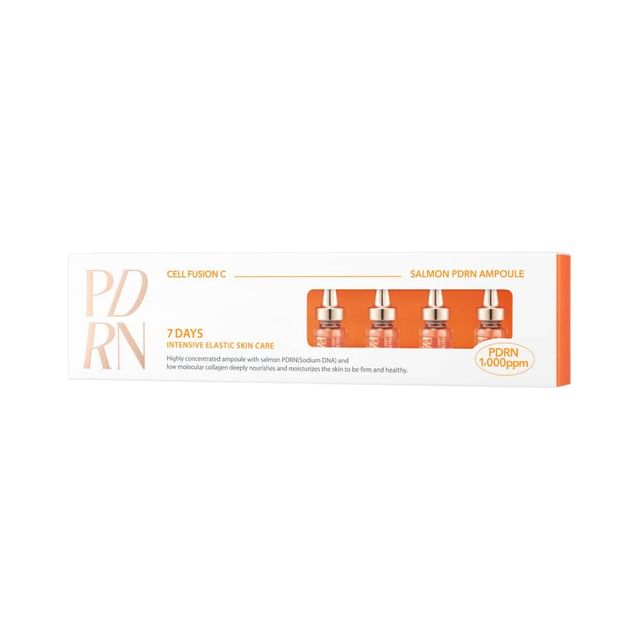
Salmon PDRN Ampoule Set
Cell Fusion C
Professional-grade individual PDRN ampoules from dermatologist-trusted Korean dermo-cosmetic brand.
$32–40

Revive PDRN Serum
Beauty of Joseon
A traditional-medicine inspired PDRN serum from Beauty of Joseon, blending salmon PDRN with rice extract and ginseng for resilient, glowing skin.
$19–25

5 PDRN Collagen Intense Vitalizing Serum
COSRX
Multi-PDRN formula with 5 types of PDRN from salmon, centella, rice, lactobacillus, and sea grapes plus low-molecular collagen.
$30–40
Related Posts
PDRN vs Salmon DNA: What's the Difference?
PDRN and salmon DNA are often used interchangeably, but they're not the same thing. Learn the key differences in molecular weight, mechanism, and efficacy between PDRN, PN, and raw salmon DNA extracts.
PDRN vs Polynucleotides: What's the Difference?
PDRN and polynucleotides (PN) are both DNA-derived biopolymers, but they differ in molecular weight, source, and clinical behavior. This guide breaks down the science and compares popular products.
PDRN Skin Boosters: Everything You Need to Know Before Your First Treatment
PDRN skin boosters are the fastest-growing segment in aesthetic dermatology. This guide covers how they work, what to expect during treatment, how they compare to HA skin boosters, and who is the ideal candidate.